
The internet won't stop explaining why it doesn't want children
How online discourse renders modern parenthood alien

Discussing why you don’t want children is an attractive online genre: highly personal, easily misconstrued, a bit rage-baity, and reliably good for engagement. There is now a glut of online content explaining a decision for which nobody is owed an explanation.
Bella Mackie’s Why I Don’t Want Children approaches her decision through the language of taste: A child would not suit the décor, it might be ugly, might be Tory, might disrupt the aesthetic flow of the kitchen. Implicit in the satire is a truth: it’s absurd you’d even care.
The other register is moral, the topic approached from a high horse after extensive due diligence and a bit of geopolitical forecasting. Jameela Jamil’s viral essay, titled I Don’t Want Children repeated four times, reads less like a statement than an incantation. It has the cadence of someone reaching for a certainty that is not quite there. Her reasons are exhaustive: war, porn, capitalism, misogyny, algorithms, climate collapse.
In talking about the decision to have children, Jamil writes:
My friend Megan always told me she would rather one day regret never having tried it out, hurting nobody other than herself, than try it out because she’s afraid of regret, and then end up actually hating it, and then possibly hurting generations of people ahead because she isn’t good at it. I wholeheartedly share this sentiment.
In this framing, having a child and ‘getting it wrong’ means you have not merely failed but poisoned the future. The implied alternative is moral cleanliness. No harm, no mistakes, no mess.
But we are not static fragments of whatever trauma we might inherit, wedged into the tarmac of our childhood like a ‘90s compact disc someone has reversed over, irrecoverable. We grow up, interpret what we experience, integrate it, resist it, or begin anew altogether. To project otherwise is to undermine human agency.
Yet this logic of irreversibility circulates in the granular, too. The anxious Redditor logs on for a second opinion: lifestyle compatibility, creche fees, whether the mortgage will survive a reduced income. Across pages of anonymous deliberation, the same sentiment recurs: this is the one decision you cannot undo, and therefore the one you must not get wrong.
Other accounts are care-free, literally. Parenthood is just another variable, one unlived life among many, like the partner not chosen, the career not pursued, the city never moved to.
Online, our mode of consumption is vacant: a mother crying in her car for eight seconds, scroll. A reel on the cost of childcare, scroll. A confessional-flooded comment section, scroll. The content passes through the membrane of our subconscious, osmosis-like, until the ordinary experience of caring gets reduced to an abstraction, estranged from lived reality.
This dissociation is exacerbated within the discourse, where motherhood content is increasingly treated as an object of intellectual analysis.
British Instagram Mum-fluencer, who goes by Mum Bum, went viral in a reel confessing that her household jars now go straight in bin unwashed. She claimed that before children, she cared about everything: the environment, human rights, conscious consumerism… Now, she is too busy making sure she and her family stay alive to think about any of it.
‘This is how they get you’ was the consensus in the comments. A chunk of people agreeing that having children means becoming a cog in the machine, too busy surviving to care about anything bigger than yourself. And that elitists and capitalism want us having babies, to create more cogs, for more machines, with more agreeability.
This rhetoric frames the choice to not have children as a type of resistance, as if refusing to reproduce dismantles oppressive systems by keeping us politically astute. But children don’t get absorbed into some ominous external mechanism. They become it, new minds with new thoughts and attitudes. The things we treat as fixed, housing, childcare, the whole machinery that governs them, are constructions. Humans aren’t.
One podcaster described the falling birth rate as a modern baby strike: people refusing to have children because the social conditions are too poor to raise them in. The same idea runs back to Emma Goldman’s birth strike lectures of 1913. But the political leverage of such a strike is often misread. Some governments answer the decline by fixing the conditions, like the Nordic countries expanding childcare and parental leave. Others address the births themselves, through incentives, while the conditions that produced the shortage go unchanged, sometimes cut. There’s a perversity in a society that grows more child-centric only in the absence of children.
In both cases, if women who would otherwise want children are opting out because of conditions, is it empowering to frame that as a triumphant strike? It treats women’s vulnerability as political agency, and a constrained choice as a free one.
Despite the emphasis on poor societal conditions at the macro level, at the individual level we are often told to just do what is right for you. The kind of empty platitude a culture reaches for once it has decided you are on your own — not my baby, and all that.
What is pernicious about this individualist framing is how a desire that is entirely reasonable at a personal level, such as wanting to be well set up before starting a family, can become exclusionary once it consolidates into a set of shared expectations. If having children becomes contingent on owning the home, holding the secure job, presenting the settled couple, then children become the preserve of the prepared, the moneyed, the do-gooders. Everyone else absorbs the message that their child would be a mistake.
But scroll long enough and the world reveals itself as no place for a child. Mother earth? Unfit parent. Algorithms draw the consensus that we live in a uniquely difficult time: climate crisis, techno-fascist leaders, looming collapse. Having a child has come to seem audacious, brazen, irresponsible, even. There’s a reflexive incredulity to it: wow, it’s 2026 and people are really still bringing kids into this mess?
A whole genre of Tiktok videos orbit the question: kids or no kids, with various life consequences to consider, to make sure you’re making sure.
The collective insistence on certainty is interesting because it presents itself as ethical: a child deserves to be wanted, certainty proves you want them, so the unsure should abstain for the child’s sake, and the sure should go ahead. It sounds sensible, like a lot of things do when reasoned through in advance. But the logic is porous, because no amount of pre-calculation closes the gap between perceived foresight and reality.
In a viral Tiktok, a woman asks:
Are you okay with the possibility of being a single parent? Your partner might leave you, might die. Are you okay with putting someone else’s needs above your own every single day, for the rest of your life? Are you okay with that?
Each clause advances what might happen to you. The whole delivery set up to yield a no. This lens, which presents children primarily as liabilities to parents, is pervasive across this genre. But the lens could frame anything: don’t fall in love unless you’re willing to be left. A decision interrogated for its risk of loss, failure, dissatisfaction, doesn’t approve of much at all.
In another viral reel, a woman offers her audience a ‘do-you-want-kids’ exercise:
If you’re on the fence about having kids, do this. Spend 24 hours imagining you’ve already chosen a child-free life, and notice where your mind goes.
Then do the same for a life with children.
She goes on to say that when she ran the test herself, her mind turned to excited plans for the child-free life and dread for the other. The dread was taken as the answer. But a life without children is continuous with the life you already have. A life with children is unknowable from the outside. It’s trying to compare a dark room with the one that’s lit up; a test of imagination as much as desire.
The wider genre operates in the same quasi-illusory way, conjuring the thing it doesn’t want just to reject it again.
A viral video features a mother giving an honest account of her parenting experience: deeply draining, exhausting. She claims to be a one-and-done mother who was misled about all that motherhood would offer.
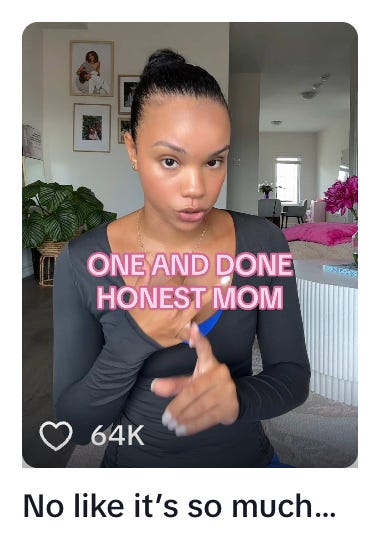
The response: finally, women are being honest! We’ve been fed the romanticisation of motherhood for our entire lives.
This is the inverse of child-free content, where a parent’s ketchup-stained confessional is taken as confirmation that life without children is, in fact, preferable.
But both the romance and the disillusionment do largely the same thing. Motherhood is reduced to a portrayal, and the interpretation of it, through a feed, rather than any lived proximity to parenthood itself, alienates.
Every narrative is available to us; Kids, no kids, struggled, celebrated, rejected, mourned. We come away charged by whatever story we unconsciously set out to hear. But a stranger’s verdict on their own life is not data. It’s just a stranger’s life.
Recently, I had childcare organised and a night out planned. At 10pm I was doing the final touches to my makeup, ready to leave, when I heard my toddler start to cry. I felt delight, a feeling at odds with what I had been socialised to expect from myself. I pictured the parallel universe, the one where I decided to feel inconvenienced: of course she would wake now just as I’m about to leave, of all times for her to wake, I’m going to be late for this gig, etc etc. That thought amused me, that annoyance can be predetermined.
But I just wanted to see her. So I went in and she settled within a few minutes. I left happy she was settled and thought about how, had I gone in resentful about timing, or having been disturbed at all, she would have felt it, and it might have taken an hour instead. I was confronted with how cultural registers are not neutral in practice. They produce the type of experiences they predict.
‘The village’ is often cited as the missing piece of modern parenting. Yet every repetition of the missing village adds to the collective anxiety around raising children, and a culture anxious about child-rearing grows less village-like in return.
What carries social currency now is self-reliance: time to ourselves, space to focus on our own work and goals, days we can schedule precisely around what’s ahead. The village is not that. It asks you to drop all your plans when someone calls, and to be loving toward the relative in your kitchen expressing some ill-timed opinions.
Western culture actively moved away from ‘the village’ dynamic; it shrank to the extended family, the extended family to the nuclear one, the nuclear one to the household of one. And now we cite the absence of the thing we discarded as a reason to begrudge.
I fell for the allure of the hypothetical village, too. Motherhood would be wonderful, I thought, if only we lived in little interdependent communities. But the village, when it existed, was never the utopia of parenthood we project backwards. Distributed care is distributed risk; a child in many hands is a child whose hours you know less about. What I’ve found, and didn’t expect to, is a strange reassurance in my child being in hands I trust completely: mine
I lay dried fusilli into a metal pot and set it on the rug with a bowl. Her eyes light up. You’re cooking pasta for our dinner. Let me get you a wooden spoon. She takes it, sits down feet first, hovering the spoon under, delicately lifting each piece into the bowl, rescuing the ones that drop. I return to my wooden cutting board. I am doing as I always did, only now there are two of us at it.
None of this matches the online rhetoric that insists a child can only ever be in the way. Out of a kind of voyeuristic curiosity I find myself browsing r/childfree, having read it was one of the more extreme corners of the internet. There, children are casually called crotch goblins, parents: breeders, and wanting children is often diagnosed as narcissism. In it sits an overarching discomfort with being claimed by someone other than yourself.
Care does not sit easily within an optimisation-centric culture, where we are encouraged to treat our own selfhood as the ultimate life project. When another person requires our time, attention, and energy, we’re socialised to see that demand as a threat, and care, subjugation.
But parenthood is inconvenient to much of what the economy values. Children disrupt the aesthetic, the schedule, the personal brand, the illusion of control. They cost everything and produce little that the machine can easily count, except future labour, which, if we are honest, is depreciating YoY. But a person, in the presence of another person, is something inherently generative.
At thirteen months, after a week of mornings knocking on her nursery’s door, I noticed something dawning on her. She flicked her wrist at every door we passed, knock, knock. Laughing to herself. Gesturing hello.
All doors can be knocked on. All the doors we see, someone lives behind them. She was grasping at this for the first time, and a street I’d walk down mindlessly was suddenly full of strangers.
In adulthood, some things become ordinary. She hands me back the strangeness of it, so that I might be present for it again, because here is someone new, pointing, asking me to look.
I watch the toddler in front of me and I cannot find the thing that makes me more than her. I have accumulated more knowledge; she has, if anything, a more immediate awareness of being alive. The difference between us is time.
This author doesn't ever really make a point? It reads like a stream on consciousness ending in 'oh but my kid is so cute so how on EARTH can ppl ever forgo this?'.
I'd hazard the writer is financially privileged, e.g not working class, not come from a working class family who struggled for resources or with things like addiction or abuse.
It's fine to sit on your high horse & go 'well I'm having a great time! You should be too!' when she brushes off very real issues like class, environment, finances.
The AMOC is set to collapse in **11 years**. 11 years til the planet starts to properly fall apart & we start seeing genuine extinction events & ultra mass migration. You are an absolute fool if you are burying your head in the sand about this.
Likewise, the class divide is now a chasm, having grown up working class me & my friends decided that wouldn't be far on kids in this current climate. Working class in the 90s got by, now ppl need 3 jobs to not be homeless, have limited access to medical care & food. You're a fucking fool if you think it's acceptable to force a child into that.
Some of us watched our best friends & our mother's struggle & suffer & decided we didn't want that AND we want to be free to support the current mothers who are being fucked over on a societal level.
Basically: don't listen to anything that comes out of middle & upper class ppl's mouths when it comes to life decisions as they have not lived in the real world & are somewhat insulated in the coming collapse.
There is something deeply depressive behind statements like "I don't want to bring a child into this world," or the idea that having a child means missing out on more fulfilling parts of life, such as material goods or experiences. Having a child is in itself a deeply meaningful experience, though it may not be a vacation. It's more profound than any vacation or spa trip could ever be. The idea that having children means missing out on life is patently absurd. Children are essential to life on a global scale, and the experience of having them will make you aware of this. They add to life, not detract from it.